
At first, there are high hopes. The valuation is agreed, the photos are taken and the listing goes live. When weeks pass, and no one has put a legitimate offer in, the excitement begins to fade and interest dries up. It starts to sink in that finding a buyer isn’t as easy as first anticipated. This is the reality of many wannabe homemovers up and down the country.
Published
03/27/2026
03/27/2026


Subscribe to the Blog
Stay up to date
For conveyancers, the Time to Sell a property (the period from listing to finding a buyer) isn’t just an estate agency KPI. It is a fundamental metric that law firms need to sit up and take notice of.
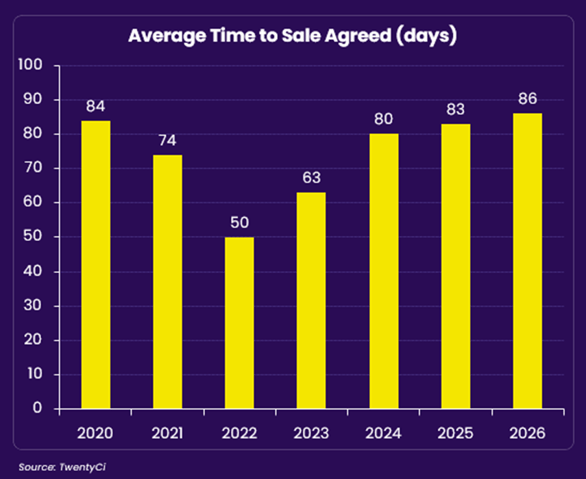
We’re currently observing the Time to Sell rise. In the year-to-date 2026, the average time it takes to secure a buyer is 86 days or 2.8 months. This is a rise of three days year-on-year and six days compared to the same period in 2024. The pandemic skewed results around 2020 to 2022, but arguably, 2023 was closer to a normal year, and even then, the Time to Sell was only 63 days.
To provide context, in 2026, we’re currently observing the highest Time to Sell in the last ten years.
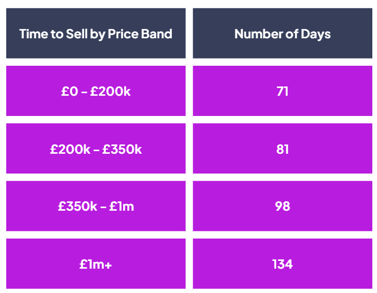
When we look at the Time to Sell across property price, it has also risen in every price bracket. Properties over £1m stand out, with an 8.6% increase (11 days) in Time to Sell year on year. On average, it now takes 134 days to sell a property in the £1m+ bracket. Perhaps this is unsurprising following the announcement of the mansion tax in November’s budget. Yet even those in the price bracket of £350k to £1m take an average of 98 days to Sales Agreed, which is over three months! It’s clear that our estate agent partners have their work cut out for them.
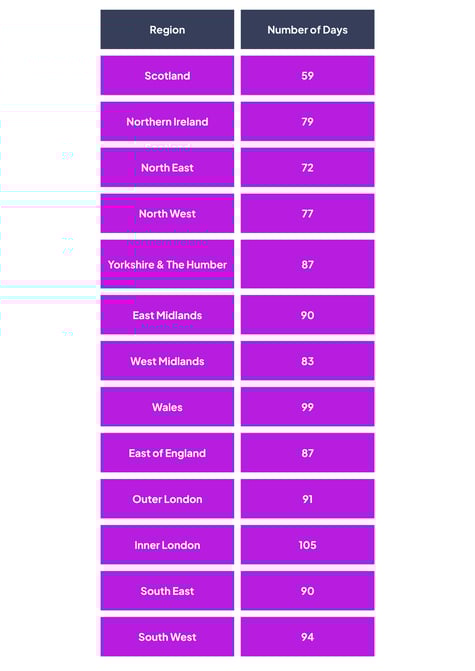
Looking regionally, Time to Sell has risen across the Midlands and the South, with Inner London showing the largest increase of +10 days. Inner London is the only region to tip over 100 days. Scottish agents sell the fastest at 59 days, which is still arguably a relatively long period. Interestingly, though, whilst the South suffers, the North is experiencing a fall in Time to Sell compared to 2025.
What does this mean for conveyancers?
All too often, conveyancers shoulder the blame for slow transactions. There’s no denying that conveyancing is elongated. The Time to Exchange (the period between SSTC and exchange) is also on the rise, 2.9% higher than in 2025. The average Time to Exchange in the UK in January 2026 was 135 days or 4.4 months. Now, when you combine that average Time to Sell of 86 days or 2.8 months with the Time to Exchange, you get a complete transaction timescale of 221 days or 7.3 months.
The unique complexity of UK conveyancing requires solicitors to navigate a web of historical covenants, prescriptive rights and complex incumbrances. UK property transactions are complex, full of risks, regulatory hoops and intricate details that law firms must navigate to get deals over the line. But now, with our estate agent partners adding nearly three months to the home buying and selling process, it’s not just a “sales problem”, it’s an “everybody problem”. Clients don’t see each part as a separate entity; they just know that the move overall is taking a long time. If any part of the process slows down, you need to be aware so you can anticipate the impact on your firm.
For starters, this will affect your pipeline. Time to Sell is important to track for future revenue and to understand any upcoming dry spells. An extended time to sale agreed can also increase the risk of fall throughs. Cold feet can manifest amongst buyers, mortgage offers can expire and life circumstances can change. All of this makes a delicate transaction even more fragile.
It’s crucial to understand how long it’s taking agents to sell, because delays weigh heavily on your clients. Never lose sight of the fact that your role is central to one of the most significant changes in their lives. The client who was once full of excitement and optimism can quickly have the wind taken out of their sails by failed or non-existent viewings, low offers or very few offers at all. By the time they’ve finally secured a buyer, pressure rises, and anxiety and impatience set in for the client. You’re suddenly handling more enquiries, chasing parties more often and shouldering additional strain. And this is all as a result of delays that may have originated further upstream.
Slower Time to Sell can also signal a wider market slowdown. It can be an early warning of falling demand, overpricing or economic uncertainty. This can lead to fewer completions in future months, more volatile workloads and potential revenue dips.
What is causing this increase in Time to Sell?
A recent article in The Times suggests that sales are taking longer because of what they refer to as “jittery buyers”. The Times highlight that conveyancing is often blamed, but suggest consumer confidence and global turbulence are causing consumers to become more reluctant to take on larger mortgages. This is backed up by the UK GfK Consumer Confidence Index, which has fallen to -19 in February 2026 from -16 in January. Looking at fall through rates, we saw 23.8% of transactions collapse in 2025. That’s 303,551 of lost sales, compared to 2019 when this was 21.9% or 268,045.
We’re currently in a “Buyer’s Market” with the year-to-date 2026 supply of new properties listed for sale at the highest it’s been in the last 10 years (up 3.3%). This means that properties that aren’t presented perfectly or realistically priced are sitting stagnant on the market.
What does extended Time to Sell mean for our Convey Alerts clients?
It’s essential for our Convey Alerts clients to stay close to the Time to Sell stats. For those unaware of our tool, Convey Alerts sends law firms notifications when their former clients newly list their homes for sale. It acts as a marketing and client retention tool in one. The law firm, once made aware of a previous client relisting, can reach out to them to offer their services once again. This is a cost-effective way to win business and improve client retention rates.
When we sign up law firms, we send them our guide on how to improve conversion rates from the Alerts. One of the key takeaways from this guide is that sending multiple communications is the best way to secure new instructions. Many sellers will not even contemplate instructing a conveyancer until they have secured a buyer. If you’re phoning up or sending out a warm email offering your services again when they’ve just listed the property, it may fall on deaf ears. By the time they sell the property, if it’s the average of nearly three months later, they may have forgotten about your email or phone call back when they first listed. However, this doesn’t mean the opportunity has disappeared. You just need to make sure that you are showing up at several touchpoints and using various communication styles (phone calls, emails, letters) to stay top of mind. If you stop contacting the homemover too soon, you fall off the radar and risk losing the instruction when they finally find a buyer and are ready to start conveyancing. It’s all about being persistent and showing up.
By marketing consistently and staying in contact with potential clients throughout their selling journey, you achieve two key things:
- You remain top of mind when they finally need a conveyancer
- When the sale eventually happens, the conveyancer who has maintained contact is often the one who gets the instruction
We also advise our law firm clients to inform sellers about the Time to Sell stats and encourage them to instruct a conveyancer earlier so that legal work can be done ahead of time. If law firms can encourage sellers to onboard early and be ‘sale-ready,’ this can cut the transaction timescale further down the line. Many homemovers are ignorant to how long the process realistically takes. If you can inform them of these timescales and how to cut this down, it will be welcomed by the homemover. No one goes into a house sale with the thought that it will take the best part of a year to finalise. Yet that’s the current reality!
Some properties sell quickly, others take months, and some may relist their property after an initial failed attempt. Without clear visibility into what’s happening in the property market, it’s easy to lose track of who is still actively trying to sell. This brings us nicely onto something else we can offer our Convey Alerts clients: Trigger Alerts.
Trigger Alerts
Some of our Alerts clients have signed up to receive our real-time Alert Triggers to refine their outreach strategies. These automated weekly intelligence reports monitor every Alert we provide, notifying you to any property status change such as sold subject to contract, withdrawn or price reductions, within the last seven days. This allows law firms to pivot their messaging with precision. You can pause marketing for withdrawn listings or accelerate ‘sale-ready’ outreach for properties that have just reduced their price and are likely seeking a faster completion. It’s all about ensuring your team is talking to the right prospect with the right message. A ‘congratulations’ on an offer or ‘let’s get you moving’ message following a price reduction makes your marketing more personalised and relevant.
Conclusion
The time it takes for a property to sell has increased in 2026. Homes are sitting on the market for extended periods, chains are slower to complete, and buyers are taking longer to make decisions. For conveyancers, an increasing Time to Sell is much more than just an estate agent hurdle. It’s a shift in pipeline and revenue flow and impacts client satisfaction. TwentyConvey will keep you up to date on the latest property market stats so you can anticipate how the Time to Sell is changing over time.
If you’re not yet a Convey Alerts client but are interested in finding out more, get in touch. If you are one of our clients and have not yet received our guide on “Driving Conveyancing Alert Conversions,” we’ll happily send this across to you. If you have any questions, please do not hesitate to reach out to a member of the team.
At first, there are high hopes. The valuation is agreed, the photos are taken and the listing goes live. When weeks pass, and no one has put a legitimate offer in, the excitement begins to fade and interest dries up. It starts to sink in that finding a buyer isn’t as easy as first anticipated. This is the reality of many wannabe homemovers up and down the country.
Published
03/27/2026
03/27/2026